
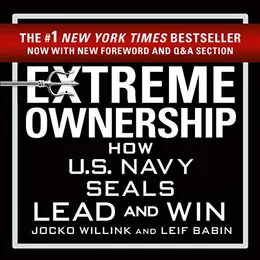
How to lead without scapegoats?
The main argument in "Extreme Ownership: How U.S. Navy SEALs Lead and Win" is that effective leadership requires taking absolute responsibility for every aspect within one's sphere of influence, regardless of external circumstances or the actions of others.
Extreme Ownership Principle:
Leaders are urged to take full ownership of every aspect within their sphere of influence, including successes, failures, and the overall mission. They should not blame others but instead find solutions and improvements themselves.
Clear communication
Leaders practicing extreme ownership admit when things go wrong and take initiative in finding solutions. This creates clear and transparent communication that keeps team members are informed and engaged.
Discipline:
Drawing on his experience as a US Navy Marine, the author emphasises discipline as a path to success. Discipline, in this context, refers to consistent and purposeful action toward long-term objectives rather than succumbing to immediate gratification or short-term impulses. Instead of being reactive or impulsive, disciplined individuals have the mental and emotional freedom to make intentional decisions that align with their values and objectives.
Leading by Example:
Leaders who practice extreme ownership lead by example. When team members see leaders taking ownership of challenges and embracing accountability, they are more likely to model these behaviors. This sets a positive standard for the entire team.
Decentralized Decision-Making:
The practical goal of extreme ownership is not that the leader has to personally troubleshoot and fix absolutely everything in the organisation. Instead it’s that by inspiring others to take extreme ownership, the organisation can become truly decentralised, where every team members is empowered to take responsibility and make decisions without micromanagement.
Commentary
- Extreme ownership emphasizes individual responsibility, but there is room for exploring how it aligns with collaborative leadership models. While individual responsibility is the norm most industries, there are situations, for example at the corporate board level, where the responsibility is shared collectively.
- The concept of extreme ownership could potentially lead to a blame culture if not implemented correctly. In situations where leaders are held solely responsible for outcomes, there is a risk of fostering a culture where individuals fear admitting mistakes or reporting issues. This risk is especially acute, if extreme ownership does come from within, but is placed on people by others.
- The relentless pursuit of extreme ownership and discipline, if taken to an extreme (pun intended), could lead to burnout. The need for constant vigilance and high levels of accountability may be unsustainable in the long term for some.
Legacy
The book challenges the common perception that leadership is primarily about wielding authority. Instead, it argues that true leadership is about taking ownership of the team's successes and failures, regardless of one's official position or rank. It also argues that discipline, often associated with restrictions, actually leads to freedom. Maintaining discipline in actions, decisions, and habits, individuals and teams can resist responding to every impulse and minor fire and instead focus on long term goals.
Order the book
Explore the book in depth and put the theory into practice.
First book free on Audible with no commitment.
Many companies have an annual personal development budget that can be spent on books!